

 English (UK)
  Deutsch
  Deutsch (Österreich)
 BEDRAIN Drainage Grids
Your advantages

High drainage capacity maintained with an overburden of up to 1,000 kPa

Excellent chemical resistance

Good cost-benefit ratio

Outstanding long-term stability
General
Drainage systems play a key role in construction, as the occurrence and quantity of water cannot always be predicted with sufficient accuracy, while structures must still be built with long-term structural stability. At the same time, controlled and responsible handling of water is essential in order to prevent damage to structures and the subsoil.
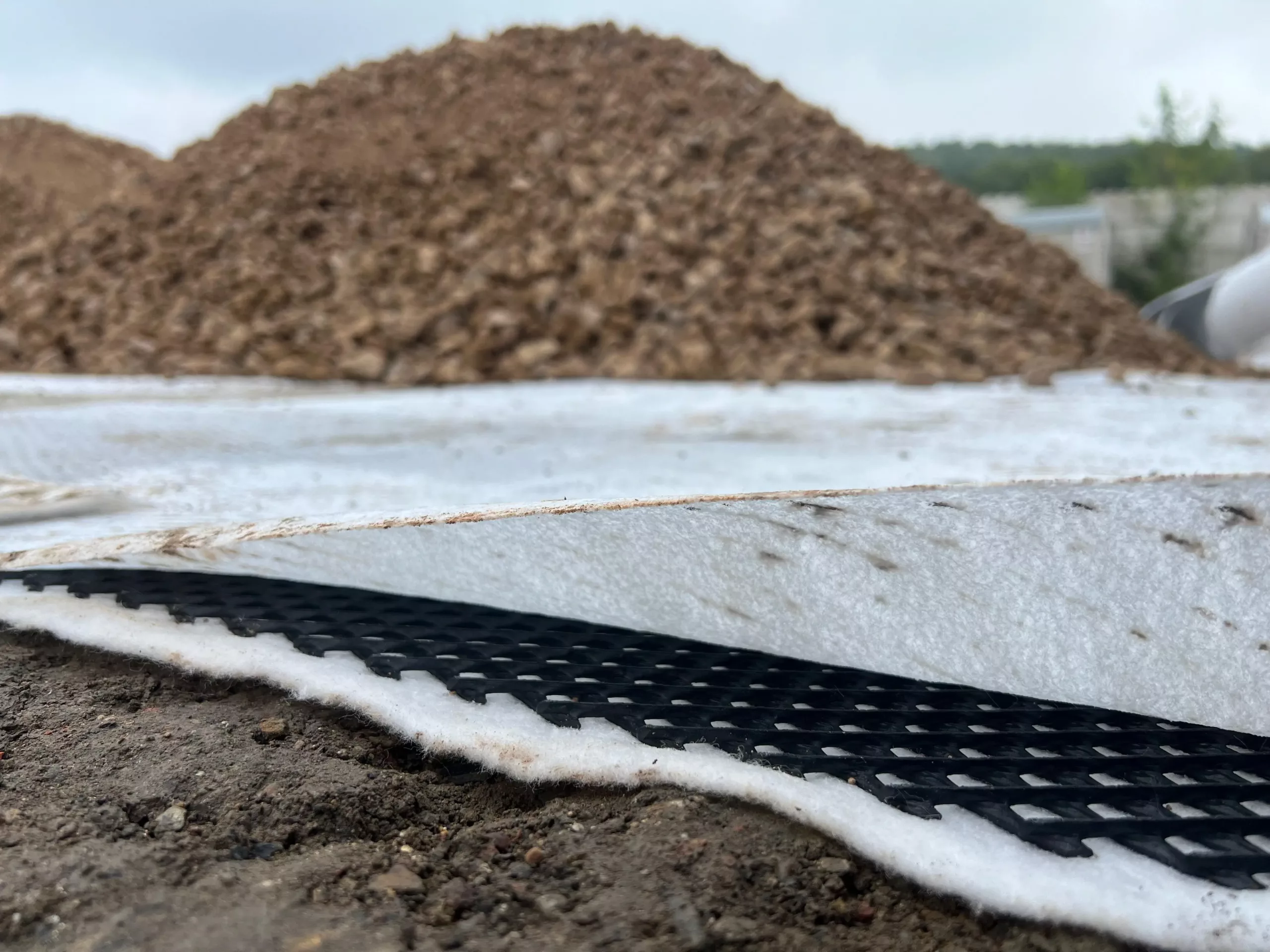
BEDRAIN Drainage Grids are particularly resistant geotextiles with a drainage core made of extruded high-density polyethylene (HDPE). This polymer demonstrates excellent chemical resistance, even to aggressive media such as soils with a high pH value.
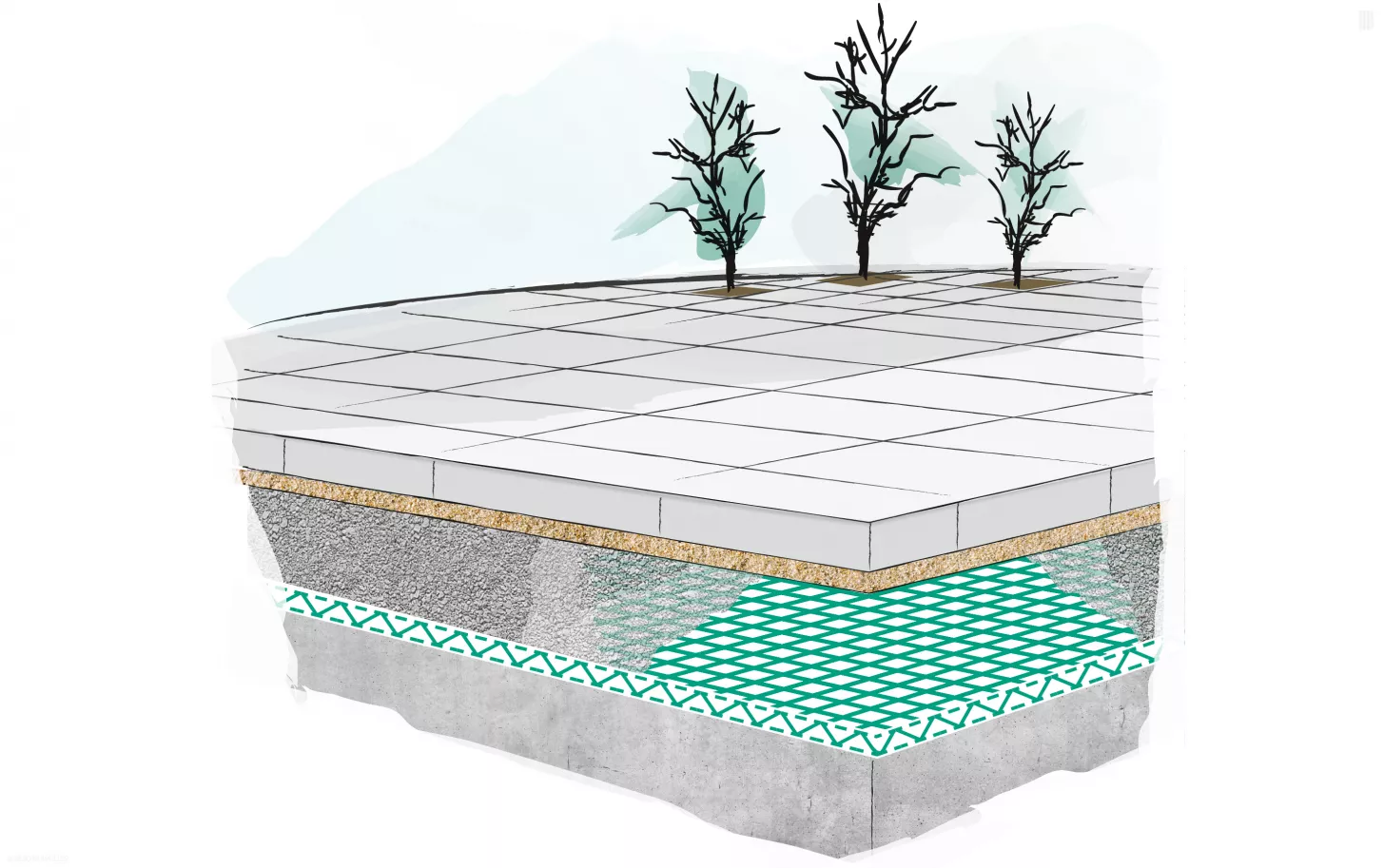

BEDRAIN Drainage Grids have excellent resistance to compressive loading. The high tensile strength of the material also enables it to withstand high mechanical loading, for example during installation. Depending on the type of application, a geotextile filter or a geotextile and a membrane can be bonded on one or both sides of the drainage core.
For structures that come into contact with soil, in the fields of civil engineering, building construction and geotechnics, the various stress cases caused by water can be divided into three main groups:
- Soil moisture
- Non-pressing water
- Pressing water
In the case of non-pressing and pressing water, BEDRAIN Drainage Grids provide useful solutions to design requirements.
Functions
Drainage
 BEDRAIN Drainage Grids can be used to full advantage on any reasonably even surface. It doesn't matter whether the surface against which the BEDRAIN Drainage Grids are to be laid is a soil subgrade or a vertical structure or building element.
BEDRAIN Drainage Grids can be laid both horizontally and vertically. The excellent pressure/compression characteristics of the grid maintain the required drainage capacity even under very heavy loading, to ensure unpressurised discharge of the collected water. Depending on the type of application, ground water, aquifer water or surface water can be systematically collected and drained away.
Filtration
 The non-woven geotextile that is bonded to the grid acts as a filter, holding back the fine soil particles and preventing them from being washed into the drainage core. The ideal aperture size creates a stable filter system, effective for all common types of soil.
Separation
 The BEDRAIN Drainage Grids can also be used as a separation layer in the boundary layer between two different types of soil. This can increase erosion stability and also lead to an increase in interfacial tension due to the draining of the interface. This increase in tension at the contact surface is an important factor in the structural analysis of surface sealing systems in landfill sites, for instance.
Applications
Bridge abutments (in compliance with german standard drawing RiZ Was 7)
BEDRAIN Drainage Grids with a bonded geotextile on both sides meet the requirements of german standard “Was 7” for the drainage of contact surfaces between bridge abutments and backfill materials.
They also represent a cost-effective alternative to hand-laid concrete filter blocks, since the rolls of drainage grid are significantly easier and quicker to install.

Bridge abutments (in compliance with german standard drawing RiZ Was 7)
1. Coarse-grained soil | 2. Backfill | 3. BEDRAIN Drainage Grids | 4. Base drainage pipe | 5. Concrete base | 6. In-situ soil
Protection of structures and buildings
As with bridge abutments, BEDRAIN Drainage Grids can be used on the soil side behind concrete cantilever wall or other facing elements. The filtering function of the bonded geotextile is of particular benefit here. The fine particles of the backfill soil cannot be washed out. As a rule, a drainage grid with a geotextile bonded on just one side, the side in contact with soil, is sufficient.
As in the two previous examples, BEDRAIN Drainage Grids can also be used to provide vertical drainage for basement walls. The grids support the sealing effect of a bituminous waterproofing coat and protect it from damage when the excavation pit is backfilled and compacted.
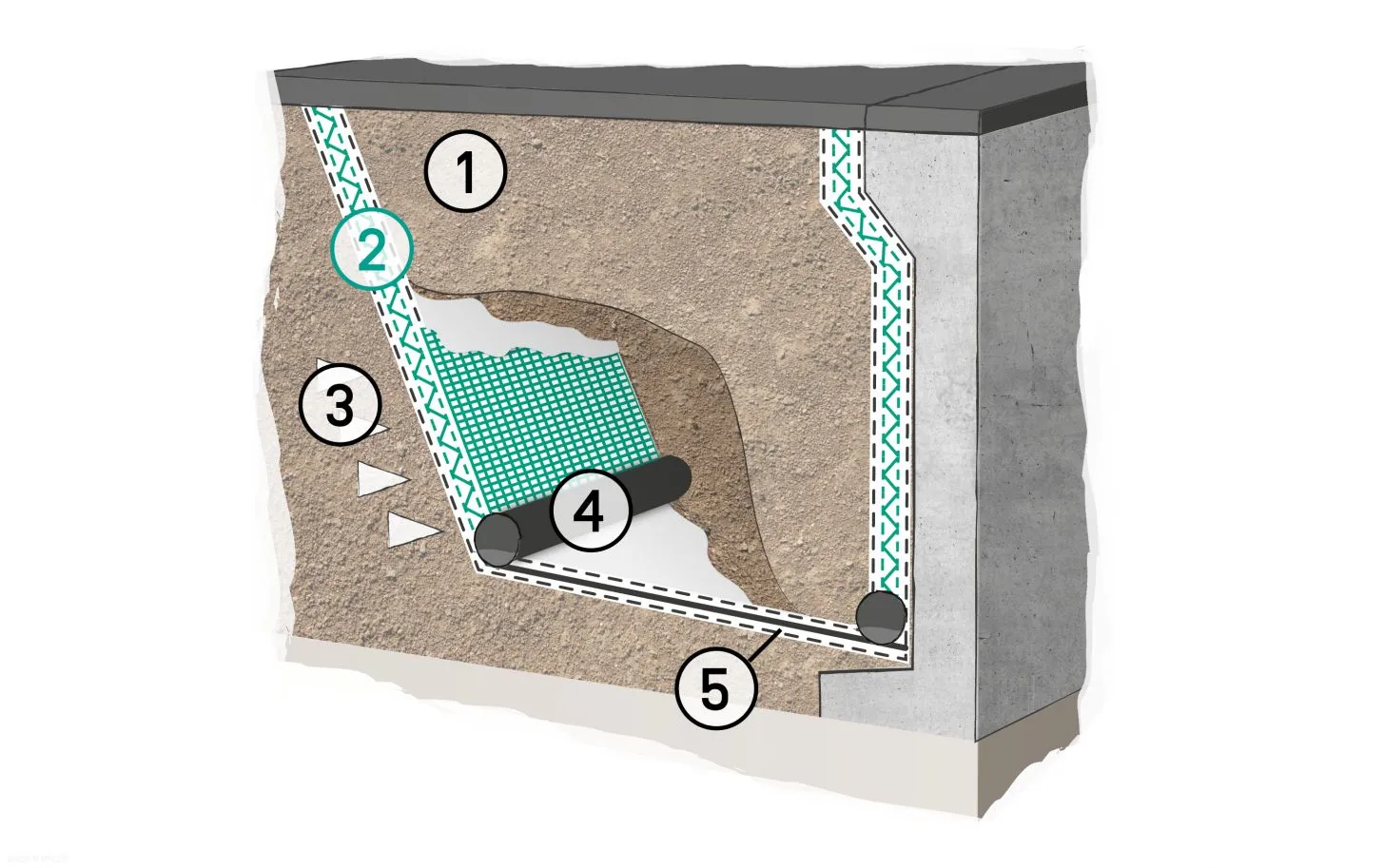
Drainage of backfill to structures
1. Backfill | 2. BEDRAIN Drainage Grids | 3. Seepage water | 4. Perforated pipe | 5. Protective layer
Landfill sites and contaminated sites
Due to their excellent durability and chemical resistance, BEDRAIN Drainage Grids can be used for the purpose of gas and water drainage in landfill sites.
As part of the surface sealing system of landfill and contaminated sites, BEDRAIN Drainage Grids increase the structural stability of the sealing system by draining seepage water away quickly and effectively.

Landfill and contaminated sites
1. Recultivation soil | 2. BEDRAIN Drainage Grids | 3. BENTOMAT Geosynthetic Clay Liner | 4. Leveling layer | 5. Geotextile as a separating layer | 6. Landfill waste
Paved surfaces
One of the special features of BEDRAIN Drainage Grids is their suitability for use as a high-performance horizontal drainage layer under roads and paved areas.
The combined benefits of reduced layer thickness and high drainage capacity, even under heavy loading, make it possible to create stable solutions for green roofs, multi-storey car parks, tunnels etc.
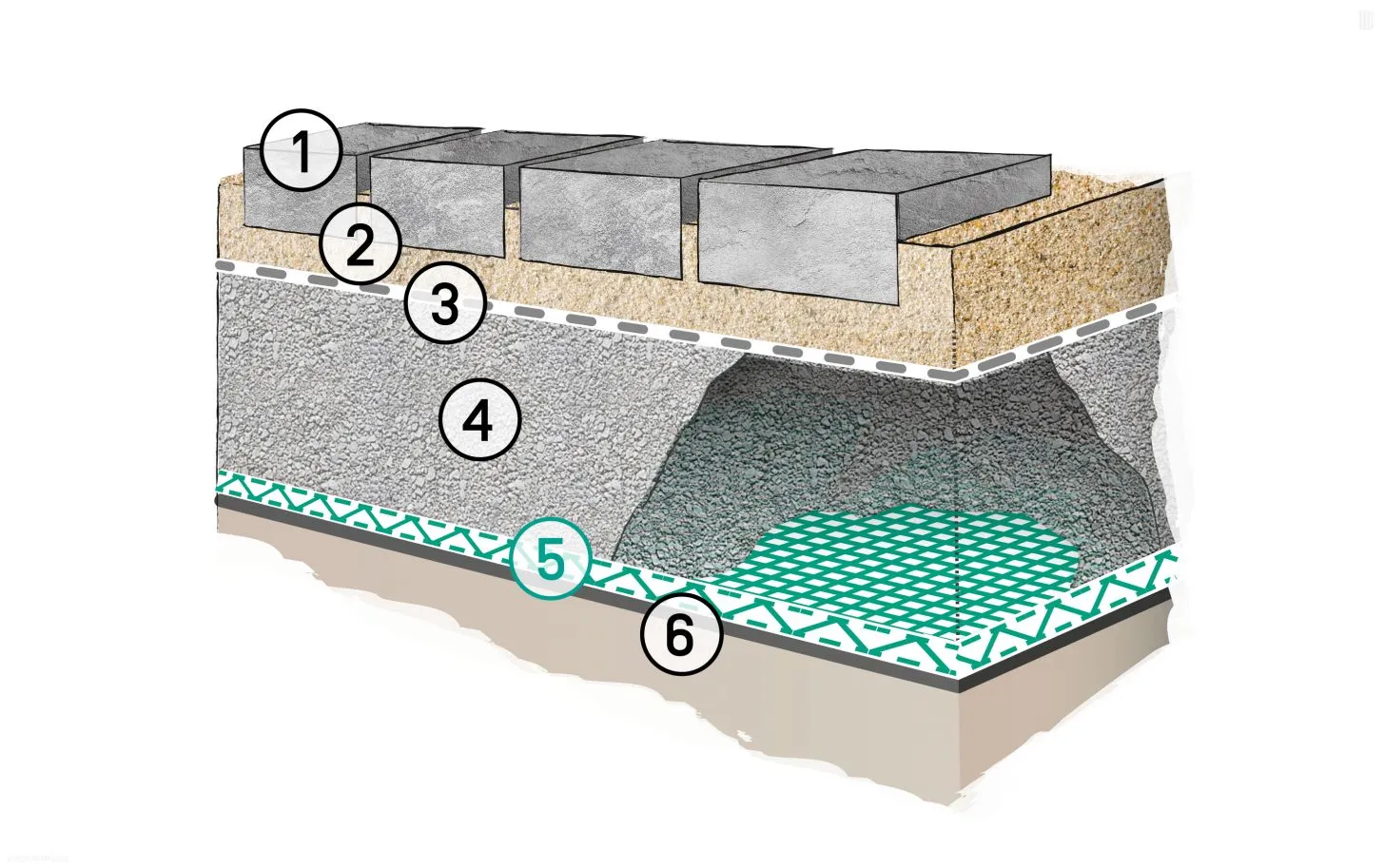
Paved surfaces
1. Paving | 2. Sand bedding | 3. Non-woven separation and filter fabric | 4. Base course | 5. BEDRAIN Drainage Grids | 6. Roof sealing membrane
Data
| Properties | VG 1 | VG 3 | VGV 1 | VGV 3 | WAS 7 |
|---|---|---|---|---|---|
| Product type | Drainage grid with one-sided non-woven fabric |
Drainage grid with double-sided non-woven fabric |
|||
| Raw material | Drainage grid: PEHD; Non-woven: PP | ||||
| Thickness (mm) | 5,3 | 9,6 | 5,5 | 10,0 | 5,0 |
| Non-woven fabric | 160 g/m2 | 120 g/m2 | |||
| Areas of application | |||||
| Bridge abutments | ● | ● | |||
| Roof greening | ● | ● | |||
| Landfill construction and contaminated sites | ● | ● | ● | ● | ● |
| Drainage systems | ● | ● | ● | ● | ● |
| Protection of foundation walls | ● | ● | ● | ● | ● |
| parking decks | ● | ● | |||
| Road and traffic areas | ● | ● | |||
| Underground car park greening | ● | ● | |||
| Tunnel constructions | ● | ● | |||
Installation
- The subsoil surface should be as smooth and even as possible in order to ensure full contact with the composite material across its entire surface.
- The drainage grid must be laid flat and without creasing. Creases resulting from the shape of the structure should be removed by cutting the material and allowing it to overlap like roof shingles.
- The longitudinal joints must be formed by butting the drainage cores together. The geotextile that projects on one side should overlap the neighbouring grid to form a continuous filter layer. At the edges of the area to be drained, the geotextile overlap at the sides should be folded down around the drainage core to prevent fine particles from washing into the drainage grid from the side.
- At the end faces of the area to be drained, a strip must be cut from the drainage core so that the nonwoven geotextile overlaps and can be folded around the end faces of the drainage core in the same way as at the sides. Alternatively, an additional nonwoven geotextile can be used.
- Vehicles must not drive directly on the geosynthetic material. When filling and compacting material on top of the drainage grid, care must be taken to prevent displacement or creasing of the drainage grid.
Our detailed installation and laying instructions for BEDRAIN Drainage Grids must also be observed.
Advantages
- High drainage capacity maintained with an overburden of up to 1,000 kPa
- Excellent chemical resistance (even to chlorinated hydrocarbons), well into the highly alkaline range
- Easy to prepare and easy to lay
- The bonded nonwoven geotextile has good mechanical and hydraulic filter properties
- Outstanding long-term stability
- Robust, to cope with installation conditions on site
- Good cost-benefit ratio
Gallery







Further information about:
BEDRAIN Drainage Grids
Further applications