

 English (UK)
  Deutsch
  Deutsch (Österreich)
 Bentonite Mats
Bentonite mats are geosynthetic clay liners (GCLs) used wherever a long-lasting barrier against liquids is required – in landfill construction, road and civil engineering, hydraulic engineering, as well as in flood protection and dike systems.
Advantages of Bentonite Mats

High sealing performance due to swelling bentonite

Self-healing of minor damage

Economical construction method requiring significantly less material than a mineral sealing layer.

Economical overall system
What Are Bentonite Mats (Geosynthetic Clay Liners)?
Bentonite mats – also known as geosynthetic clay liners (GCLs) – are multilayer composite materials made of polymeric and mineral components.
This combination product is manufactured from geosynthetics and clay, typically sodium bentonite. When in contact with water, the bentonite swells and forms a durable, self-healing impermeable barrier.
They are used wherever conventional sealing systems are too complex or uneconomical. Compared to purely mineral clay liners, bentonite mats achieve the same sealing effect with significantly reduced layer thickness.
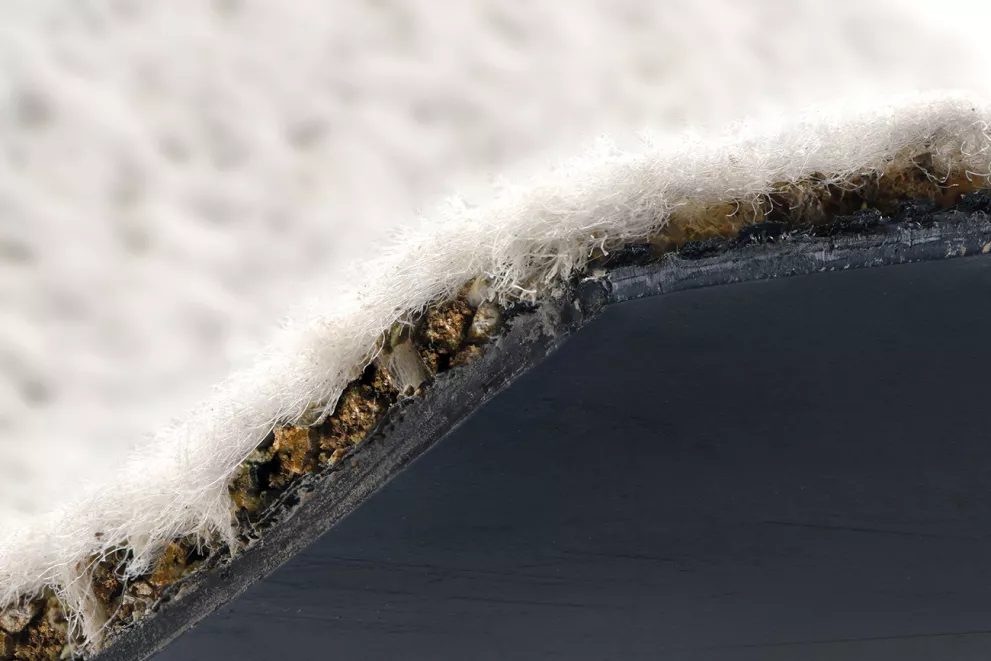
Structure and Function of Geosynthetic Clay Liners
A typical geosynthetic clay liner consists of a geotextile cover layer, an evenly distributed core layer of bentonite, and a geotextile carrier layer. These layers are needle-punched together across their entire surface, creating a stable, mechanically bonded composite. The use of bentonite granules instead of powder prevents dust formation during installation and minimizes material loss.
When exposed to moisture, the bentonite swells, closing pore spaces and creating a homogeneous, water-impermeable sealing layer. The so-called self-healing effect ensures that minor mechanical damage is automatically sealed.
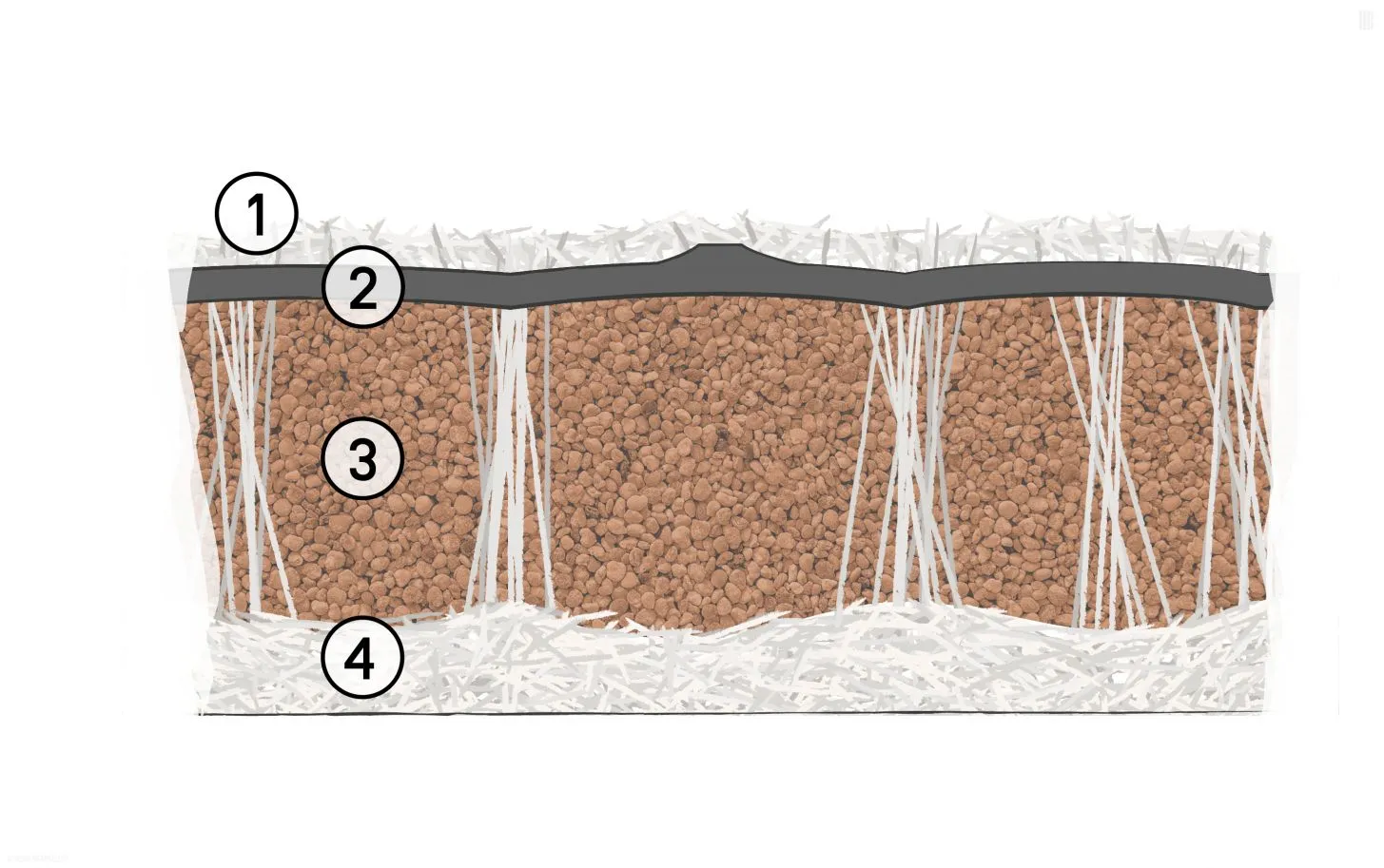
Cross Section of a Bentonite Mat
- PP fibres (needle punched from the non-woven fabric side)
- PP woven geotextile
- Bentonite
- PP non-woven fabric
Some GCL variants are factory-laminated with an additional PE membrane, providing extended protection against desiccation and, in certain applications, serving as a root barrier.
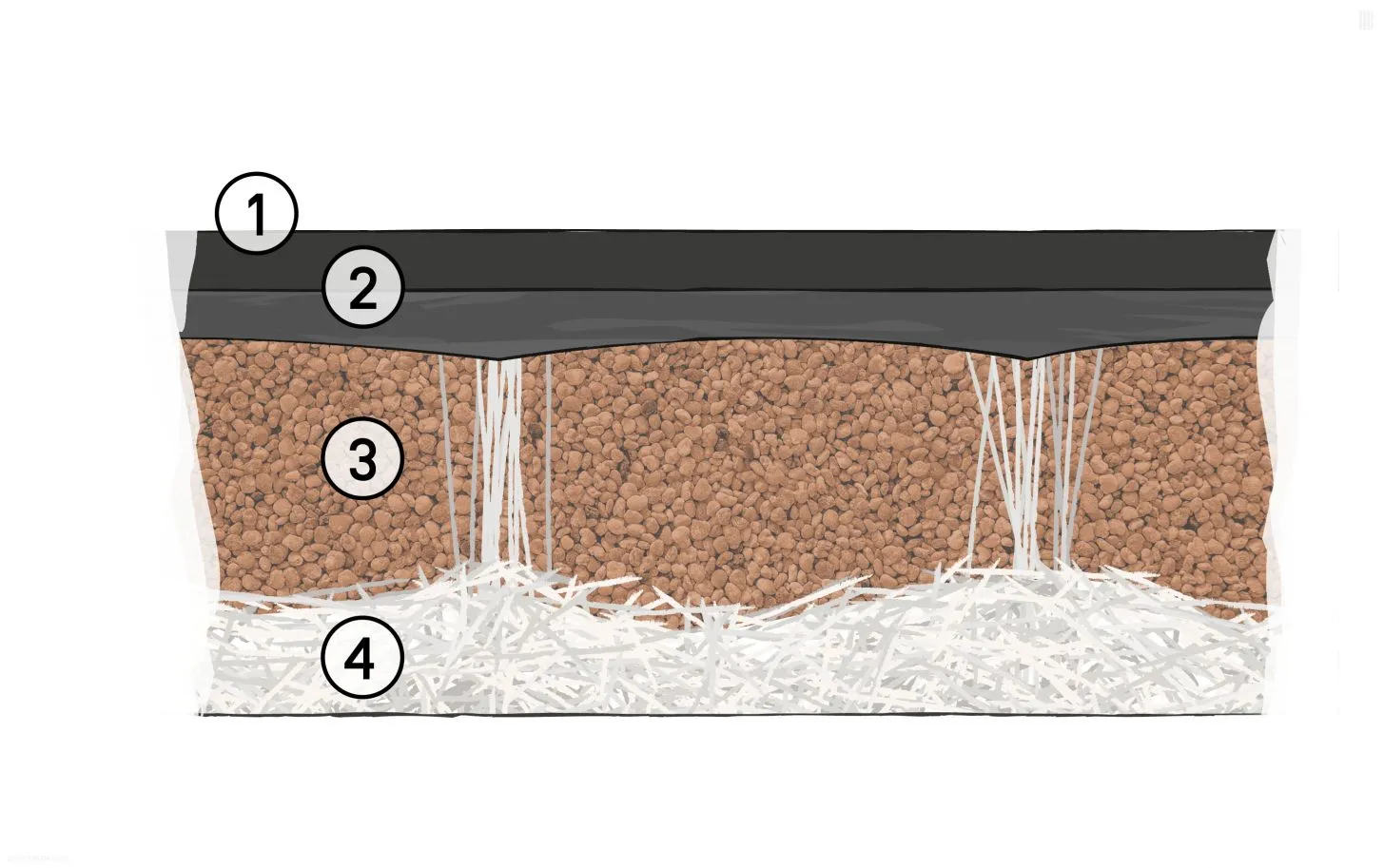
Cross Section of a Bentonite Mat with PE Membrane
- PE membrane
- PP woven geotextile
- Bentonite
- PP non-woven fabric
Contact Us for the Right Bentonite Mat for Your Project
Whether for sealing retention basins, traffic areas, or landfills – our team of experts will support you in selecting and planning the optimal bentonite mat solution for your application.
Application Areas of Bentonite Mats
Road and
Transport Infrastructure
In infrastructure construction, geosynthetic clay liners act as a seal and limit the entry of water-hazardous substances into the subsoil. For groundwater protection in road construction and water catchment areas, compliance with RiStWag (Guidelines for Structural Measures in Water Protection Zones) is required.
Typical applications:
- Rainwater retention basin
- Overflow and storage basins
- Groundwater protection in traffic areas
- Multi-storey and underground car parks
Landfill sites
In landfill engineering, bentonite mats serve as a mineral sealing component within multi-layer barrier systems. In capping layers, they help reduce or prevent infiltration of precipitation into the waste body, minimizing leachate generation.
For such applications, the requirements of the German Federal Waste Working Group (LAGA) are decisive. LAGA defines uniform quality standards and suitability assessments for sealing systems, ensuring compliance with the technical requirements of the Landfill Ordinance (DepV). GCLs approved under LAGA guidelines meet the strict quality criteria for Class I and II landfill applications.
Hydraulic and
Hydraulic Engineering
In hydraulic construction, bentonite mats are used to seal reservoirs, retention basins, ponds, embankments, and canals. They prevent water loss and contribute to the long-term stability of hydraulic structures.
Remediation of Contaminated Sites
In environmental remediation, bentonite mats encapsulate contaminated soils or materials within engineered barrier systems, reducing infiltration of precipitation and leaching of pollutants. This allows safe reuse of formerly contaminated land for infrastructure or industrial purposes.
Installation of Geosynthetic Clay Liners
Installing a bentonite mat is a straightforward process when manufacturer installation guidelines are followed.
The rolls are laid with an overlap of approx. 30 cm, and the overlapping area is sprinkled with loose bentonite granules to ensure a continuous seal.
The subgrade must be even, firm, and free from sharp objects. Installation should be carried out under dry weather conditions and with wrinkle-free alignment. After installation, the mats must be immediately covered with suitable fill material to prevent premature hydration and mechanical damage.
Bentonite Mats vs. Compacted Clay Liners
4,500 m² compacted clay liner (0.5 m thickness)
= 2.250 m³ of clay
4.500 m² bentonite mats
= 22 rolls

A bentonite mat with only a few millimeters
of thickness achieves a hydraulic conductivity
comparable to 1-meter-thick compacted clay liners.
The resulting advantages include:
- Reduced material demand and transport costs
- Faster installation
- Increased usable area on landfills and construction sites
- No shrinkage cracks due to needle-punched bonding
Frequently Asked Questions (FAQ)
What is the difference between bentonite mats and compacted clay liners?
Bentonite mats differ from compacted clay liners in that they are industrially manufactured, geosynthetic systems with consistent quality. With a layer thickness of around 1 cm, they offer the same or better sealing performance as up to 1 m of compacted clay while allowing faster, more precise installation.
How does the self-healing effect of GCLs work?
The self-healing effect is based on the high swelling capacity of sodium bentonite, which can expand up to eight times its original volume. This property allows bentonite to close small holes or cracks automatically when hydrated.
What is the service life of geosynthetic clay liners?
When properly installed and covered, GCLs remain effective for decades. Long-term studies confirm their excellent chemical and biological resistance, with no measurable decline in performance even after many years. In landfill applications, LAGA-approved GCLs have demonstrated a service life exceeding 100 years.
What should the subgrade condition be before installing bentonite mats?
The subgrade must be level, compacted, and free from sharp stones, roots, or debris. It must also be dry before installation. Uneven or point-loaded areas may damage the liner and impair its sealing performance.
Do bentonite mats require covering after installation?
Yes. Bentonite mats must be covered immediately after installation—ideally on the same day—with at least 30 cm of suitable soil or granular material. This load prevents premature swelling from moisture and secures the liner in place, protecting it from mechanical damage during construction.
Are bentonite mats suitable for pond construction?
For small garden ponds or decorative basins, bentonite mats are usually not recommended. They require sufficient overburden and constant water contact. In large-scale retention or storage basins for civil and landscape engineering, however, they are highly effective. For smaller private ponds, flexible polymer liners are generally the better choice.
Bentonite Mats – Consultation and Solutions from BECO BERMÜLLER
Whether for landfill construction, retention basins, or other sealing applications, BECO BERMÜLLER is your reliable partner for bentonite mats and geosynthetic sealing systems. Our team provides assistance with product selection, system design, and project planning, ensuring safe, efficient, and durable construction solutions.
Further information about:
Bentonite Mats
Bentonite Mats
No downloads found.
Further applications