

 English (UK)
  Deutsch
  Deutsch (Österreich)
 COCONUT-FIBRE MATS and JUTE-FIBRE MATS
Your Advantages

Natural erosion control

Extremely flexible and mouldable

Natural fiber fabric, made from renewable raw materials
General
Erosion control mats made of woven coconut fibre or woven jute fibre also benefit seed germination since they balance out fluctuations in temperature. Furthermore, these fibres store water very well and release it again very slowly, and this helps prevent the soil from drying out.
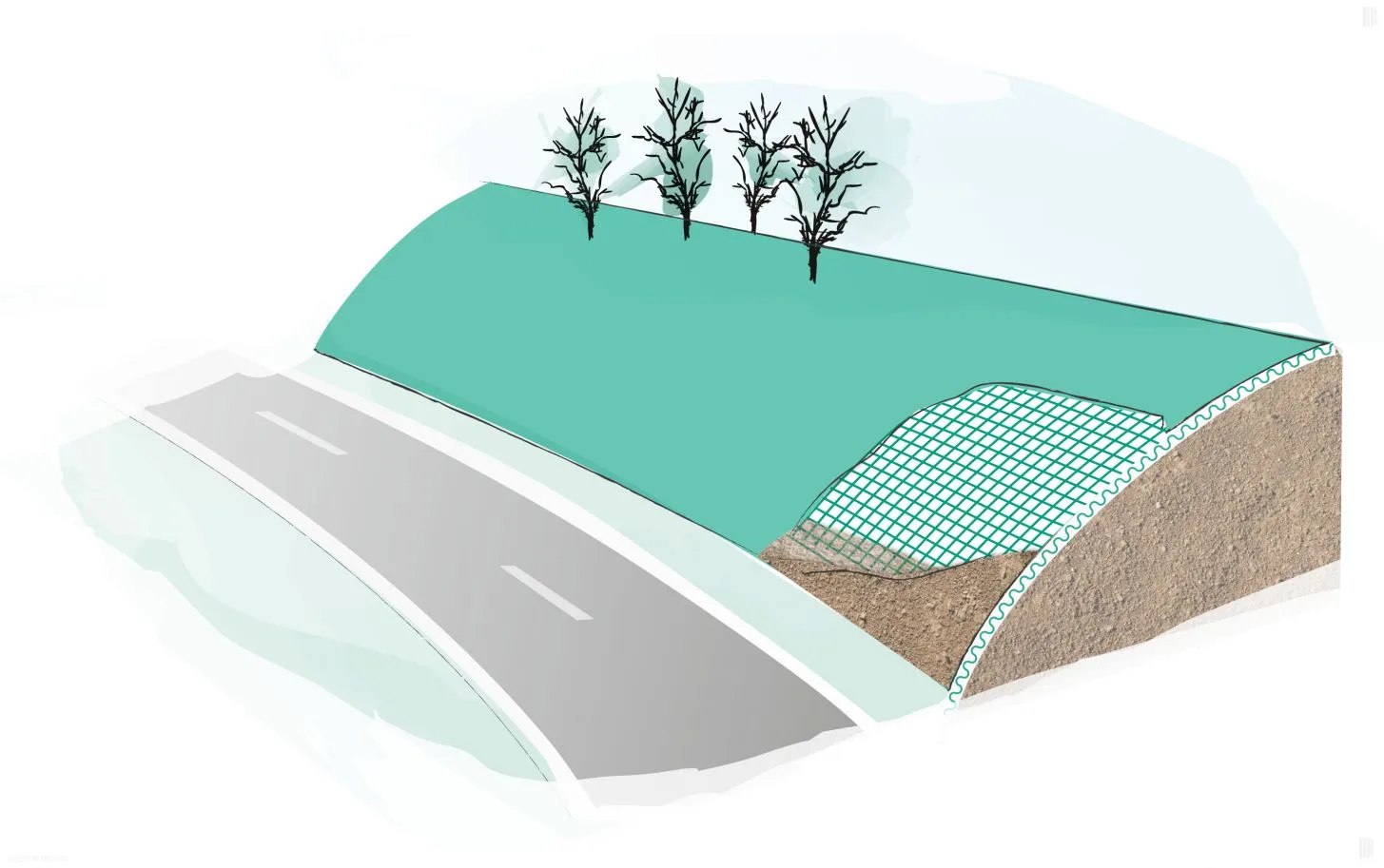

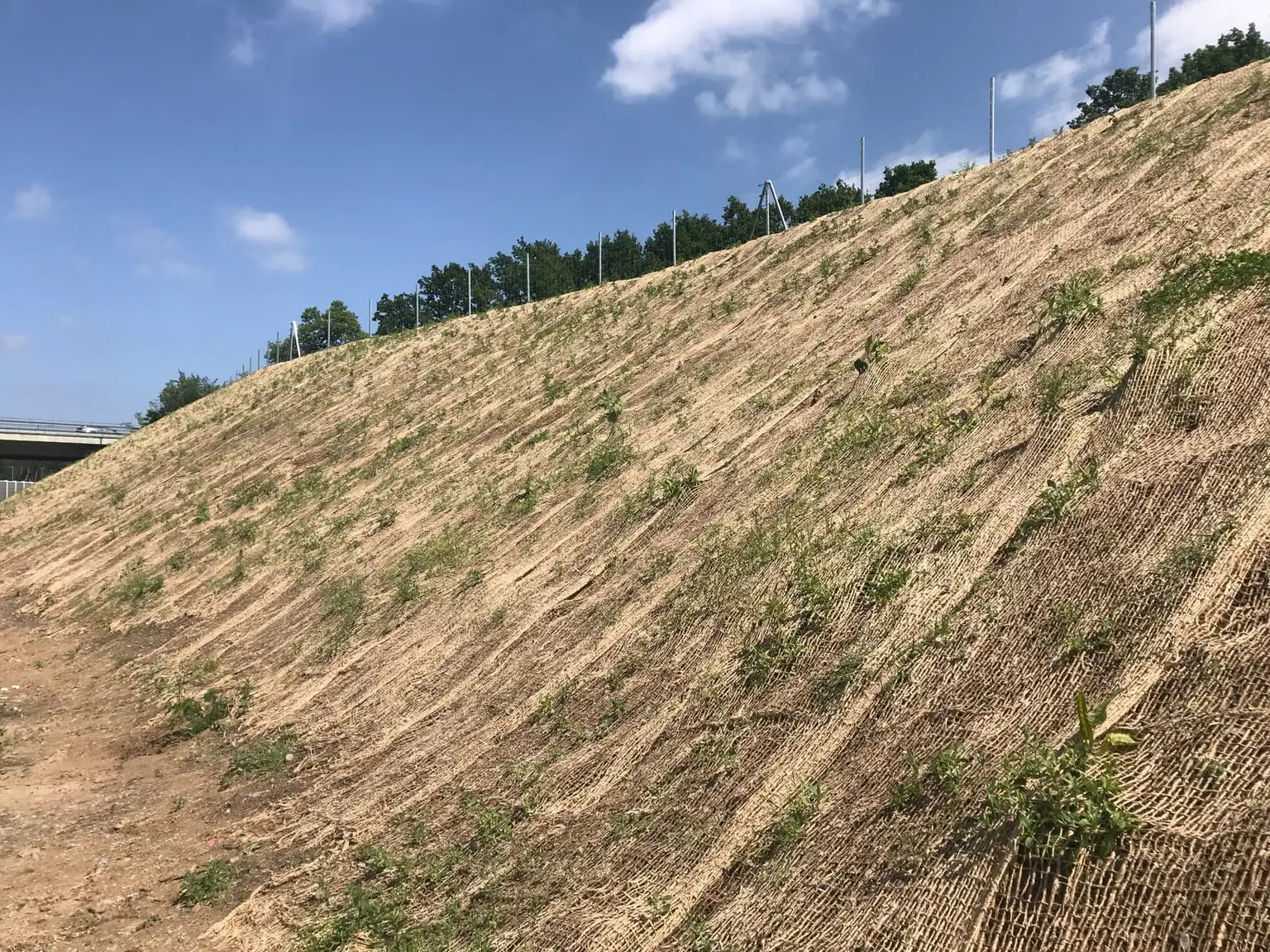
COCONUT- and JUTE-FIBRE Mats are easy to lay and they adapt flexibly to the shape of the ground – uneven surfaces can also be uniformly covered. The mats decompose depending on environmental and weather conditions and are therefore particularly suitable for short-term erosion control measures.
Fixing materials: the mats are held in place with special wooden pegs or metal fixings, depending on the type of application. These make sure that the erosion control mats are securely bonded to the subgrade and prevent them from becoming detached under the effects of weather conditions.
Functions of COCONUT- and JUTE-FIBRE-MATS
Erosion control
 COCONUT-FIBRE Mats and JUTE-FIBRE Mats provide a cost-effective solution for protecting embankments, river banks and shore areas from the undesirable erosion of soil caused by the effects of water and wind. The mats protect seeds from extreme fluctuations in temperature, creating favourable conditions for germination. These natural erosion control mats also store excess water and release it again very slowly. This prevents the top layers of soil from drying out quickly.
Applications
Inclined surfaces
In highway and water engineering there are many types of sloping earthworks that require effective erosion protection. Embankments, noise barriers, dams, dykes, rainwater retention basins, riverbanks and landfill sites are all typical fields of application for erosion control mats made of coconut fibre or jute fibre.
The subsoil must contain sufficient humus for the vegetation to be able to grow adequately.

Data
| Properties | JUTE-FIBRE 500 | COCONUT-FIBRE 400 | COCONUT-FIBRE 700 |
|---|---|---|---|
| Product type | Natural-fibre woven fabric | ||
| Raw material | Jute fibres | Coconut fibres | Coconut fibres |
| Mass per unit area (g/m2) | 500 | 400 | 700 |
| Mesh size (mm) | 20 – 30 | 20 – 30 | 15 – 20 |
| Max. long./transv. tensile load (kN/m) | 8 / 5 | 10 / 10 | 18 / 11 |
| Service life* (years) | 1 | 3 | 3 – 5 |
| Areas of application | |||
| Embankments up to 1:1.5 | ● | ● | ● |
| Embankments up to 1:1 | ● | ● | |
| Embankments steeper than 1:1 | ● | ||
| Initial growth support | ● | ● | ● |
| Temporary erosion control | ● | ● | ● |
| Ski slopes | ● | ||
| Shore protection | ● | ||
| Summer dykes | ● | ● | |
| Rainwater retention basin | ● | ● | |
| Flood barriers | ● | ● | |
| Zone between high and low water | ● | ||
M AEBEL Tool: Passendes Erosionsschutzsystem finden
Mit unserem interaktiven M AEBEL Tool finden Sie in wenigen Klicks die regelkonforme Erosionsschutz-Lösung für Ihr Projekt. Vier Angaben zur Böschung genügen, um passende Produkte direkt vorgeschlagen zu bekommen.
Installation of COCONUT- and JUTE-FIBRE MATS
- The erosion control mats must not be exposed to the elements during storage or transport. Otherwise, mould growth and premature biodegradation could occur.
- The subgrade must be even and free of stones and lumps of earth.
- The subsoil must contain sufficient humus for the grass to be able to grow. Otherwise, the surface must be covered with a humus layer at least 5 cm thick and screeded off to create an even surface.
- The seed must be suited to the location and be sown evenly and in sufficient quantities.
- The erosion control mats must be in contact with the subgrade over their entire area, since growth, vegetation and erosion control are only possible if direct contact is ensured.
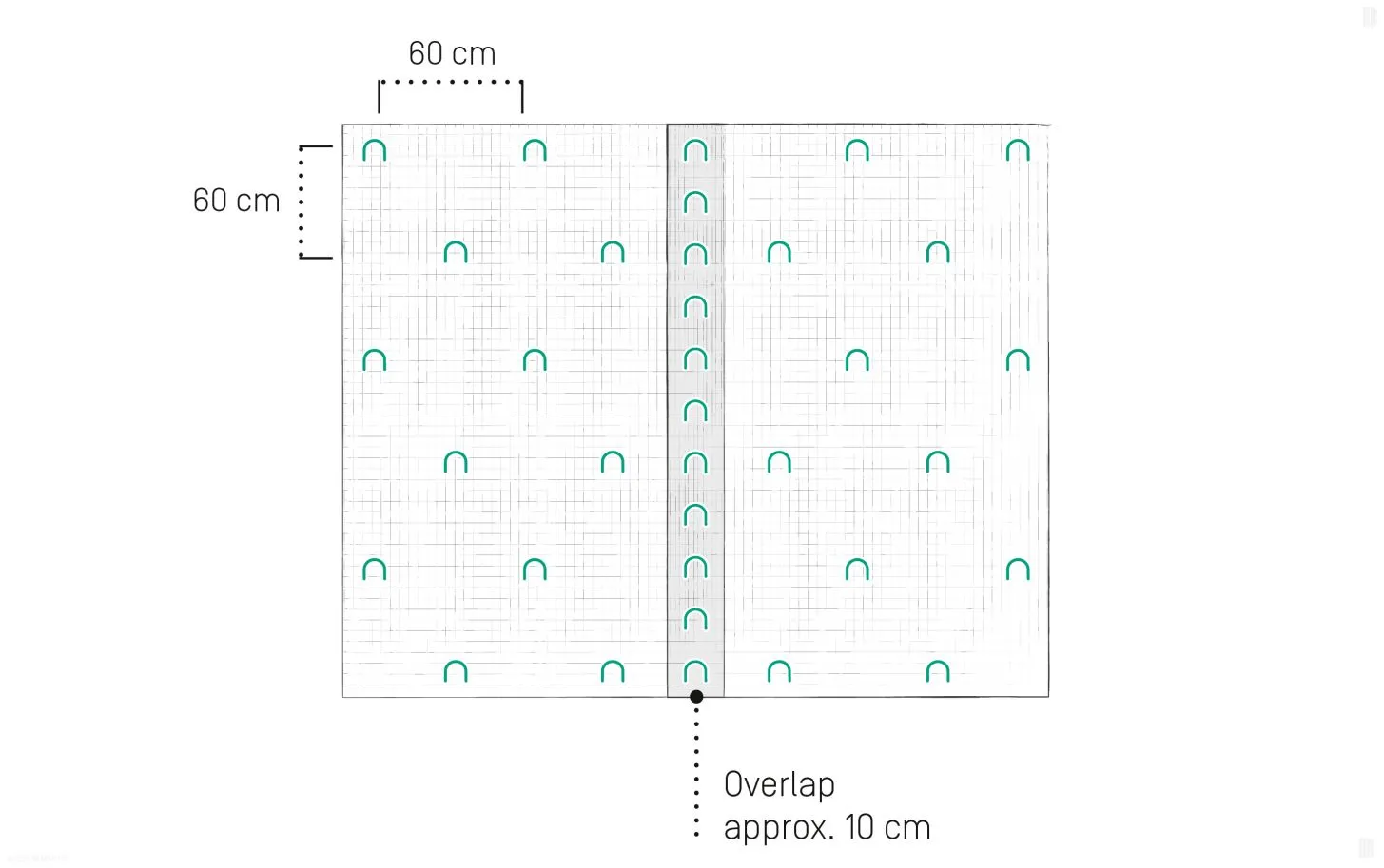
- The mats are fixed at grid intervals of approximately four to five fixing points per square metre, depending on the gradient.
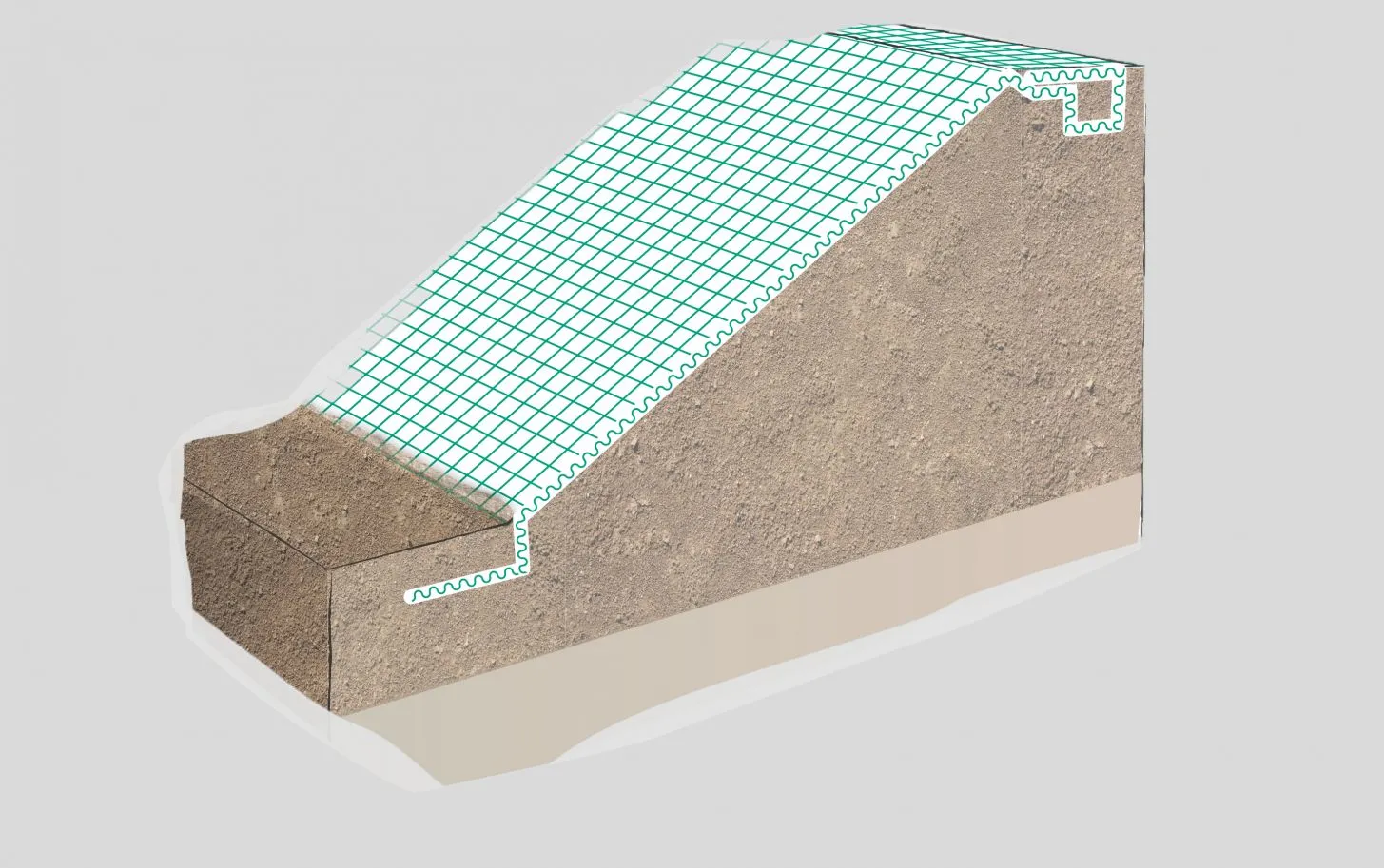
The erosion control mats must be secured at the top and bottom of the slope in adequately dimensioned embedding trenches.
Fixing materials
The permanent fixing of open-mesh embankment mats made of jute or coconut plays an essential role in ensuring successful erosion control. Usually, clips, staples, fixings or clasps made of metal, plastic or wood are used for this purpose. These make sure that the erosion control mats are securely bonded to the subgrade and prevent the mats from becoming detached under the effects of weather conditions. Depending on the soil properties, the slope inclination and the type of application, the special wooden pegs or metal fixings are used.
Wooden pegs
The wooden stakes with cross dowels are made of wood and remain in the ground after installation. They are used mainly for close-mesh fabrics and predominantly soft or sandy soils.
Metal fixings
The metal fixings are the preferred option for fixing wide-mesh erosion control fabrics or when used on predominantly compact soils.
Fixing grid
The overlap must be planned with the direction of the prevailing wind in mind, so that the wind does not blow directly under the edge and lift the mat.
Slope < 1:5
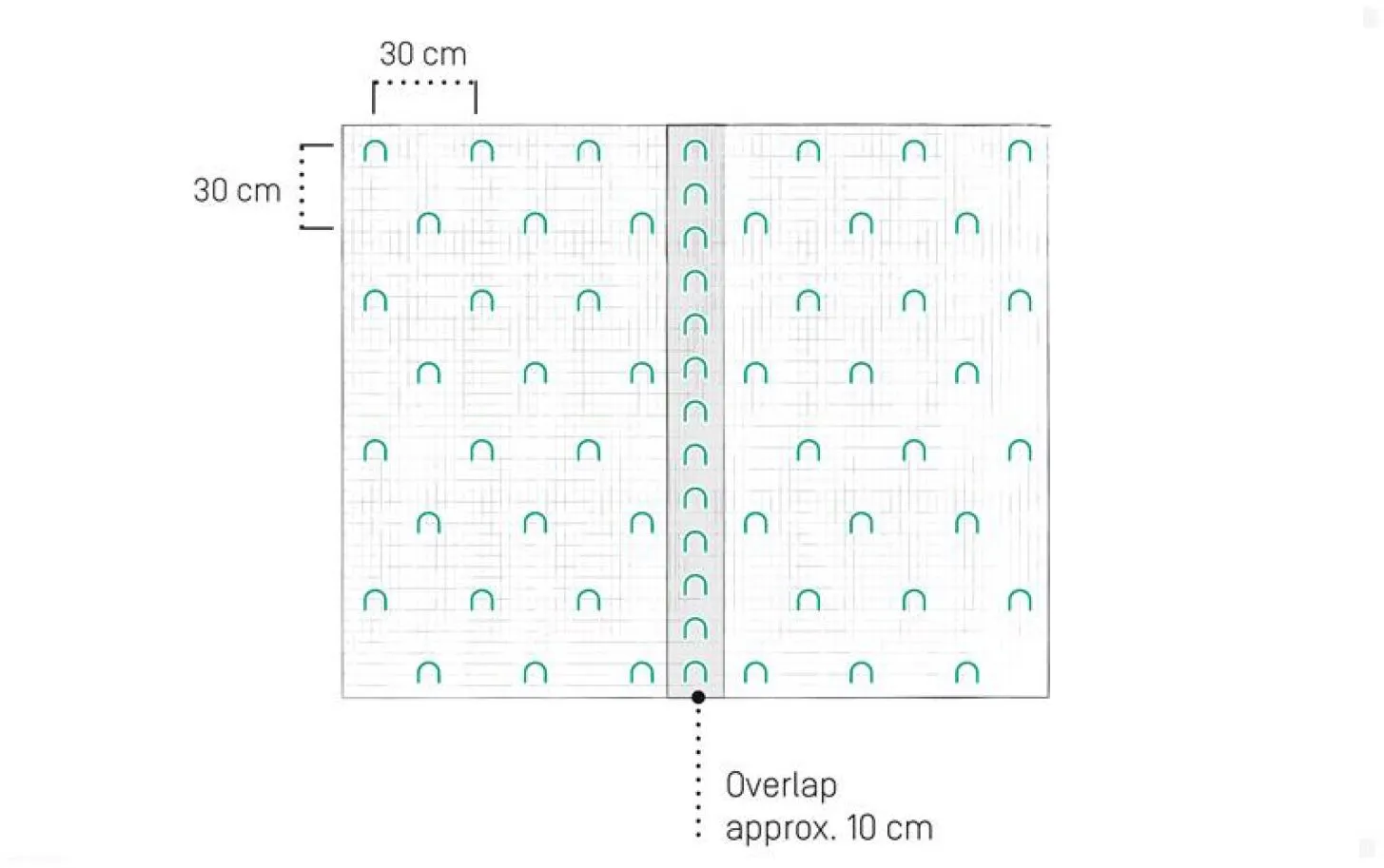
Slope ≥ 1:5
Material and Environment
Slope protection and erosion control with natural fiber fabric
Ecology and sustainability are decisive criteria when selecting erosion control products. When it comes to temporary erosion control measures and gentle slopes, biodegradable mats made of jute-fibre and coconut-fibre fabric are the first choice.
The COCONUT-FIBRE Mats are made of double-twisted coconut yarn. They are not chemically treated and are therefore completely biodegradable. The mats have a service life of three to five years, depending on the environmental and weather conditions.
The wide-mesh JUTE-FIBRE Mats decompose over a period of one to two years, depending on the environmental and weather conditions. The mats are therefore ideal for providing short-term erosion control.
Natural-fibre fabrics are also suitable for recultivating and securing raw soils as well as for protecting slopes. If, after construction measures, only a small amount of humus-rich soil capable of supporting vegetation remains, natural-fibre mats can be used to prevent leaching of the remaining fine soil particles and to form a basis for the development of a new soil layer.
Made from renewable raw materials

Nature fiber products
Advantages
- Natural erosion control
- Secure bedding of seeds
- High water storage capacity
- Wide range of applications
- Extremely flexible and mouldable
- Made from renewable raw materials

Further information about:
COCONUT-FIBRE MATS and JUTE-FIBRE MATS
COCONUT-FIBRE MATS and JUTE-FIBRE MATS
| COCONUT-FIBRE MATS and JUTE-FIBRE MATS | |
|---|---|
| COCONUT-FIBRE MATS and JUTE-FIBRE MATS Product Brochure
| Download |
Further applications