

 English (UK)
  Deutsch
  Deutsch (Österreich)
 Construction of a sealed storage area for the temporary storage of concrete rubble and building rubble
Geosynthetics as a cost-effective alternative to concrete slab

The Requirements
On the premises of Kieswerk Hardt GmbH & Co. KG, a BBO (Bodenseekreis Bau-schuttaufbereitung GmbH & Co. KG) collection centre is operated. Recycled building materials are produced from the temporarily stored mineral building rubble material. The storage and operating area must be paved in such a way that controlled drainage and seepage of the waste water produced can be ensured.
The original implementation planning had envisaged a water-impermeable concrete slab.
The area was originally a gravel extraction site, which was later filled with excavated earth. The soil investigation for the proposed slab construction indicated a fill layer thickness of approximately 7 m and showed that the soil mechanics properties of the fill material vary locally. This meant that the proposed concrete slab would require a sub-base layer that would even out these differences.
Thus, in addition to the considerable costs for the slab itself, there would have been additional costs for excavation, for the removal of the excavated soil, and for the installation of the sub-base material.
The Solution
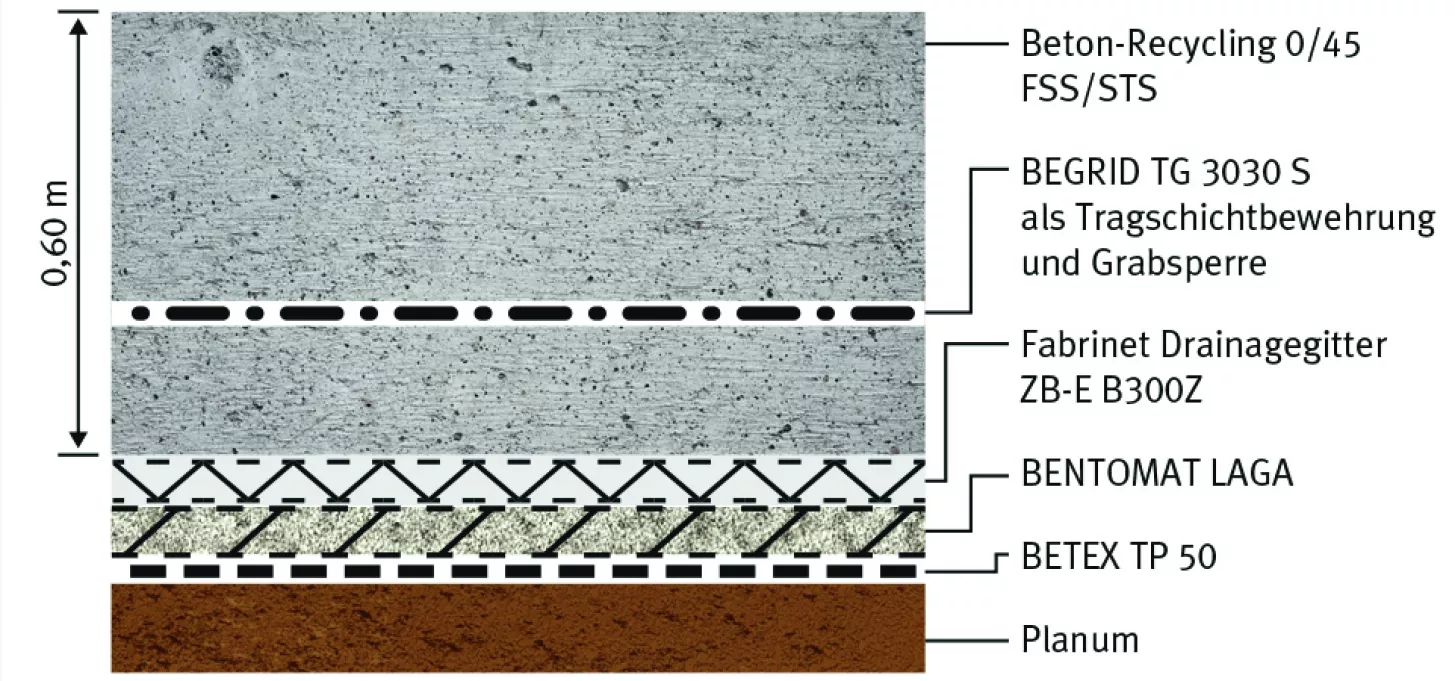
Structure of the sealed storage area
Since the proposed slab was a very high-cost solution, BECO BERMÜLLER worked with geologist Tobias Hoelz, of Geoteam A2 GmbH, Argenbühl, to develop a new proposal that would significantly minimise the amount of excavation and provide a technically equivalent solution using geosynthetics.
The Result
As a result of the chosen configuration and layer structure, in addition to the effective prevention of uncontrolled surface water seepage into the subsoil, further disadvantages of a concrete slab were avoided.
The geosynthetics based layer structure can absorb settlement of the subsoil without incurring any damage. With a concrete slab, on the other hand, differences in the settlement of the subsoil could result in cracks forming on the surface of the slab. Water could then penetrate through these cracks or even permeate the entire slab. The water in the cracks would destroy the slab in the long term due to freeze/thaw cycles and, in combination with mechanical stress, would cause it to become permeable.

Covering of the sealing system
By using geosynthetics as reinforcing and sealing elements, the construction costs of the project were significantly reduced. And if the structure ever needs to be dismantled in the future, this will involve considerably less effort than the removal of a concrete slab.
Advantages
- Evens out any settlement
- Reliable long-term sealing
- No costly and extensive concreting necessary
- Concrete work required
- Very safe and proven construction method
- High design reliability for the project participants
- Inexpensive and economical system solution
- Ecologically sustainable construction method